


> Home > >

Madonna del latte
.jpeg)
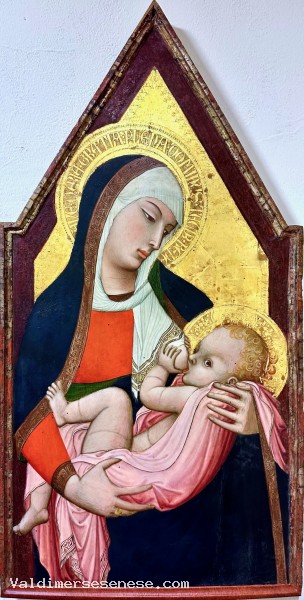
Artist: Ambrogio Lorenzetti
Year: 1325 circa
Current location: Oratorio di S.Bernardino - Museo Diocesano
Original location: Eremo di Lecceto
DESCRIPTIVE INFORMATION
Tempera and gold on panel, 96 x 49.1 cm.
The "Madonna del Latte," painted on wood by the Sienese painter Ambrogio Lorenzetti around 1340, is venerated as the patron saint of the "Pio XII" Seminary in Siena. The work, originally from the seminary's summer residence at the Lecceto monastery, was transferred to the seminary in 1866, then located in the convent complex of San Francesco. It was later (1953) placed in the chapel of the seminary's new headquarters in Montarioso. In recent years, it was transported and exhibited at the Diocesan Museum, due to its invaluable artistic value. Indeed, the painting demonstrates Ambrogio Lorenzetti's innovative pictorial research, which emphasizes the naturalistic nature of his depiction, presenting concrete aspects of human life and contemporary society. Unlike previous 14th-century panels and those of Byzantine tradition, Mary is not positioned in a dominant central position; she is moved to the left to give more space and prominence to the lively baby Jesus and to highlight their affectionate relationship. It is precisely this bond that constitutes the protagonist of the painting, which we could define, in the words of Chiara Frugoni, as "maternal love filtered through a suffused melancholy." The Virgin Mother supports the dynamic child with powerful hands and a firm grip, kicking with a natural movement, and leans her serene face toward him to observe him as he nurses, sucking with childlike avidity from the breast on which his tiny hands rest. The two figures, thanks to this close correlation of gestures, integrate harmoniously, forming a single group; This interaction is emphasized by the play of colors: the intense blue of the cloak enveloping the Virgin stands out against the iridescent pink of the embroidered drapery from which the tender body of Jesus emerges. The monumentality of the group is further emphasized by the use of a purplish border, which delimits the gold background, and beyond which the figures are painted so as to appear to be peering out from the wooden frame.
Madonna del latte.jpeg)